


- As modern kitchens keep upgrading toward minimalist layouts and smart storage solutions, cabinet drawer systems are no longer limited to basic storage functions. Today’s market demands drawer systems that deliver smooth sliding performance, extended service life, high load-bearing capacity, and seamless compatibility with all contemporary cabinet styles.
- For furniture factories, cabinet processors, distributors and hardware importers, picking suitable drawer systems is no longer a simple matter of choosing the lowest price. Such purchasing decisions directly affect finished product quality, customer satisfaction, on-site installation efficiency and long-term after-sales maintenance expenses.
- Based on industry research covering Europe, Asia and North America, under-mount concealed slides, slim drawer boxes and modular storage hardware represent the fastest-growing segments within the furniture hardware industry. With rising consumer expectations, mastering the internal structure, performance specifications and core purchasing criteria of modern drawer systems has become a mandatory skill for all procurement specialists.
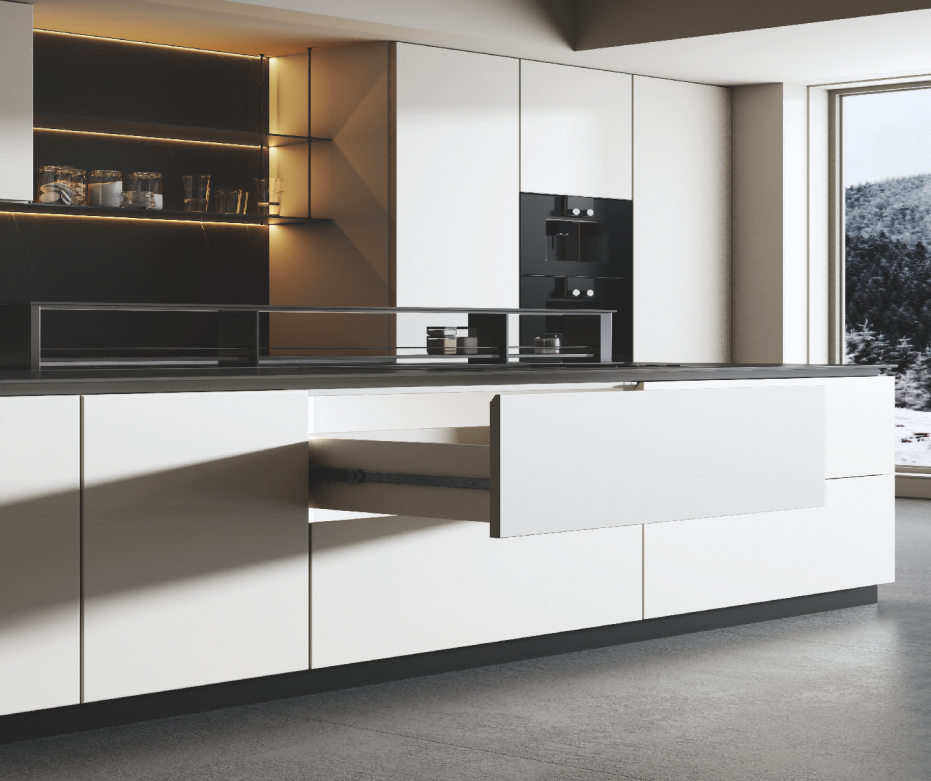
Why Cabinet Drawer Systems Are Growing More Critical Than Ever
- A decade ago, most cabinet manufacturers relied on traditional wooden drawers paired with side-mounted slides. While these products met basic storage needs, they carried prominent drawbacks: limited load capacity, exposed hardware, complicated installation, and inconsistent operating experience across batches.
- Consumers nowadays hold far higher standards. Modern kitchens must satisfy the following requirements:
- Full-extension sliding design
- Silent operation
- Soft-close buffer function
- Minimalist and elegant appearance
- Maximum space utilization rate
- Long-term wear resistance
Against this backdrop, integrated cabinet drawer systems have become standard fittings for mid-to-high-end cabinetry. Industry trends prove storage space optimization ranks among top factors that influence customers’ cabinet purchasing decisions, especially in urban residential markets where usable space is limited.
A Complete Breakdown of Modern Cabinet Drawer System Structures
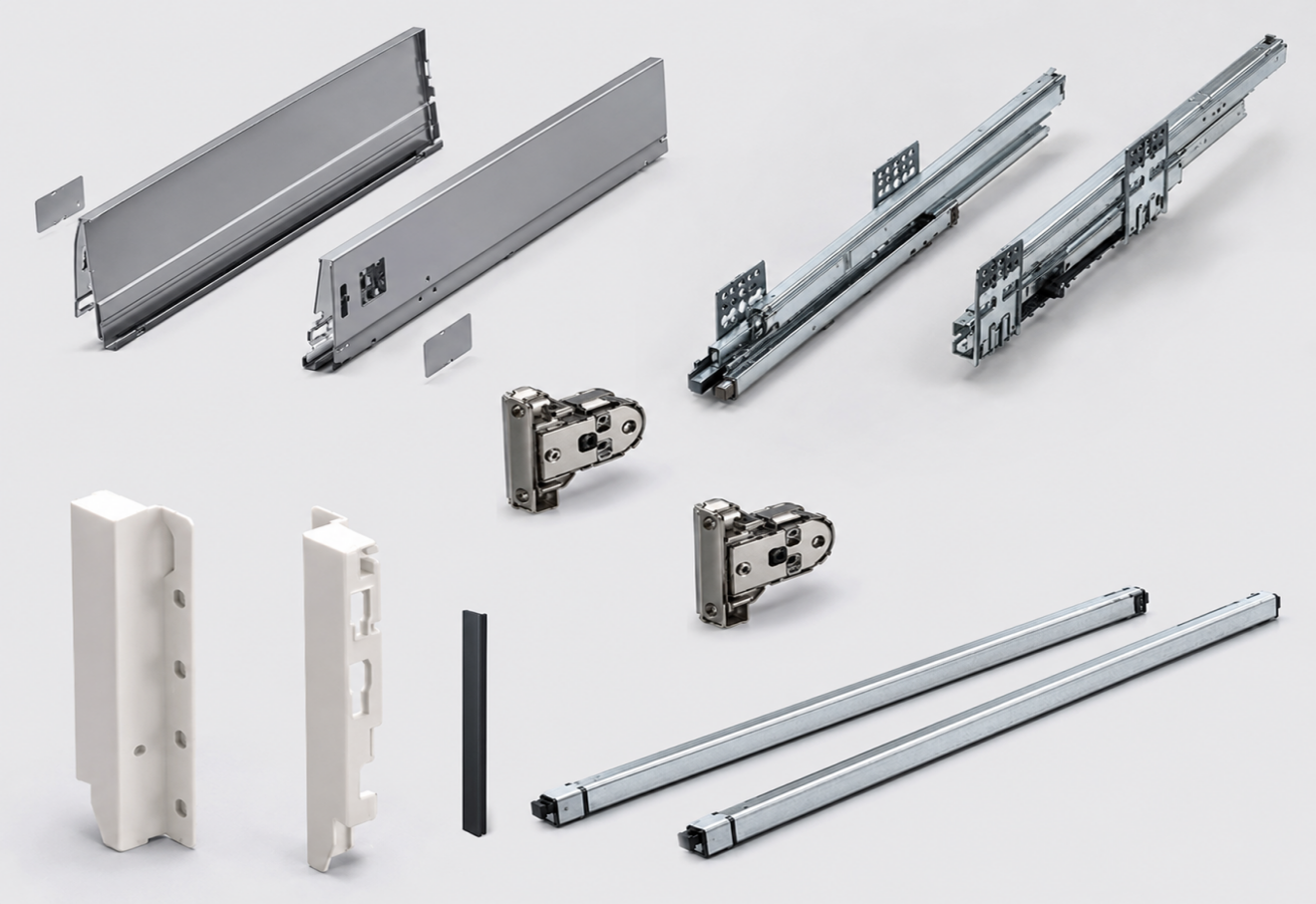
Many buyers mistakenly believe drawer systems only consist of slides. In reality, a complete drawer system is a precisely engineered assembly where multiple components coordinate with one another.
Core Components
Drawer Side Panels
Exposed metal side walls that deliver structural rigidity and supporting force.
Drawer Base Panel
The load-bearing foundation of the drawer, evenly distributing the weight of stored items.
Rear Baffle
Connects two side panels and reinforces overall structural stability.
Front Panel Connectors
Enable precise fine-tuning of gaps and flatness between drawer fronts and drawer bodies.
Concealed Under-Mount Slides
Installed under drawers for seamless sliding with fully hidden hardware.
Buffer Damper Unit
Regulates drawer closing speed and absorbs impact force during opening and closing.
The coordination of all parts enables consistent stable performance after tens of thousands of open-close cycles, even under daily frequent use.
Four Mainstream Cabinet Drawer System Categories for 2026
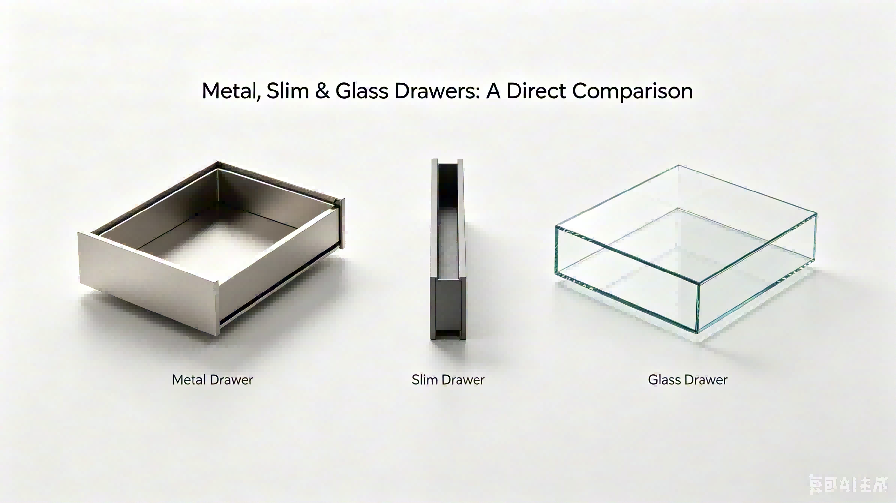
1. Double-Wall Metal Drawer Systems
Double-wall metal drawers remain one of the most widely adopted solutions for residential and commercial furniture.
Advantages
- High cost-performance ratio
- High structural strength and deformation resistance
- Simple assembly operations
- Compatible with mass industrial production
- Less premium texture compared with slim drawer boxes
- Limited range of customizable shapes Typical applications: standard household cabinets, wardrobes, office cabinetry
Disadvantages
2. Slim Drawer Box Systems
Market demand for slim drawer boxes has surged dramatically over the past five years. Side panels are merely 13–14 mm thick, delivering a neat clean look while greatly expanding internal storage volume.
Advantages
- Premium light-luxury appearance
- Larger internal storage capacity
- Matches mainstream modern home decoration styles
- Extremely high recognition in European and Indian marketsq
- Higher mold development and production costs
- Strict precision requirements for production dimensions
Disadvantages
Currently, numerous top-tier cabinet brands list slim drawer systems as standard fittings for their high-end cabinet collections.
3. Glass Side Panel Drawer Systems
Glass side panel drawers balance practicality and visual aesthetics. They are widely adopted in high-end custom kitchens, where visual design largely drives customer purchase choices.
Advantages
- Elegant and sophisticated appearance
- Creates obvious differentiation from competing products
- Fits all high-end renovation projects
- Elevated manufacturing costs
- Higher risk of breakage during long-distance transportation
Disadvantages
4. Premium Designer-Grade Drawer Systems
Top-tier drawer systems developed by leading European hardware manufacturers set the industrial benchmark for precision and sliding smoothness.
Advantages
- Comprehensive multi-dimensional fine adjustment functions
- Industry-leading ultra-smooth sliding feel
- Mature cutting-edge industrial design craftsmanship
- Exorbitant purchasing costs
- Longer production delivery lead times Main applications: high-end villa residences, commercial renovation projects
Disadvantages
Core Metrics to Judge Drawer System Quality
Importers and cabinet manufacturers cannot evaluate product quality solely through product brochures. Multiple professional technical parameters objectively measure long-term service performance.
Load-Bearing Capacity
Load capacity is one of the most vital hard specifications. Universal industrial standards are listed below:
|
Usage Scenario |
Recommended Load Rating |
| Regular Household Cabinet Drawers | 30–35 KG |
| Heavy-Duty High-Load Storage Drawers | 40–50 KG |
| Large Wide Premium Drawers | 50–70 KG |
High-load variants are preferred for cookware storage cabinets, oversized pantry drawers and commercial cabinetry.
Open-Close Durability Cycle Testing
Repeated open-close test cycles directly reflect a product’s service lifespan. Standard grading benchmarks:
|
Product Tier |
Durability Cycle Standard |
| Entry-Level Basic Models | 30,000 open-close cycles |
| Commercial Engineering Grade | 50,000 open-close cycles |
| Top Premium Grade | 60,000–80,000 open-close cycles |
Higher cycle test figures translate to stronger mechanical reliability and lower after-sales warranty failure rates.
Anti-Corrosion & Rust Resistance
Kitchens feature constant high humidity, making rust prevention critical. Salt spray testing is universally used to verify surface coating quality. Recommended compliance standards:
|
Usage Environment |
Suggested Salt Spray Rust-Proof Duration |
| Dry Inland Regions | 24–48 Hours |
| Standard Ordinary Residences | 48–72 Hours |
| Coastal & High-Humidity Zones | 72–120+ Hours |
Products with superior anti-rust performance retain their appearance and stable functionality for extended service periods.
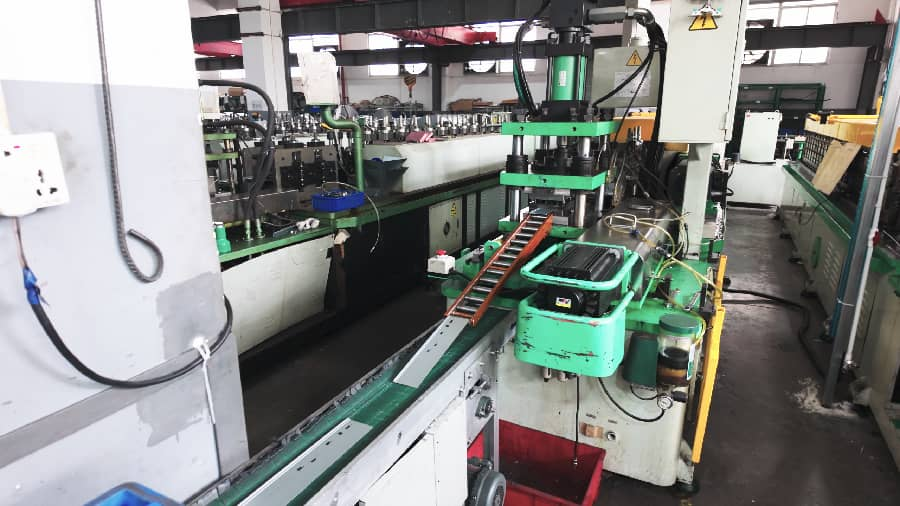
Mass Production Consistency
Perfect design cannot guarantee stable finished performance without reliable production quality control. Key audit dimensions when screening suppliers:
- Level of production line automation
- Standardized quality management systems
- Complete professional testing equipment
- Formal standardized production control workflows
- Uniform product quality across different batches
A stable mature production line impacts product dependability far more than isolated design highlights.
Domestic Chinese vs European Hardware: Which Drawer System Delivers Better Value for Money?
This question frequently arises during purchasing negotiations, and the final choice hinges on project positioning and market budget.
|
Comparison Dimension |
European Import Brands |
Domestic Chinese Manufacturers |
| Unit Purchase Price | Relatively High | More Price-Competitive |
| OEM Customization Flexibility | Heavy Customization Restrictions | Wide-Range Customization Options |
| Supply Production Capacity | Stable Output | Strong Mass-Production Capacity |
| Delivery Lead Time | Longer Lead Periods | Faster Shipment Speed |
| Custom R&D Development | Moderate Scope | Full-Range In-Depth Customization |
| Technical Iteration Speed | Mature, Fixed Technical Framework | Rapid Technology Upgrades & Iteration |
Over the past decade, numerous domestic hardware manufacturers have drastically upgraded self-developed craftsmanship, automated production lines and full-set quality control systems. Nowadays, buyers can access high-end equivalent drawer performance without paying the steep premium attached to European brands.
Domestic manufacturers represented by Garis continuously invest heavily in concealed slide technology, slim drawer R&D, fully automated production lines and complete product testing systems — this trend mirrors the overall industrial upgrade of China’s furniture hardware sector.
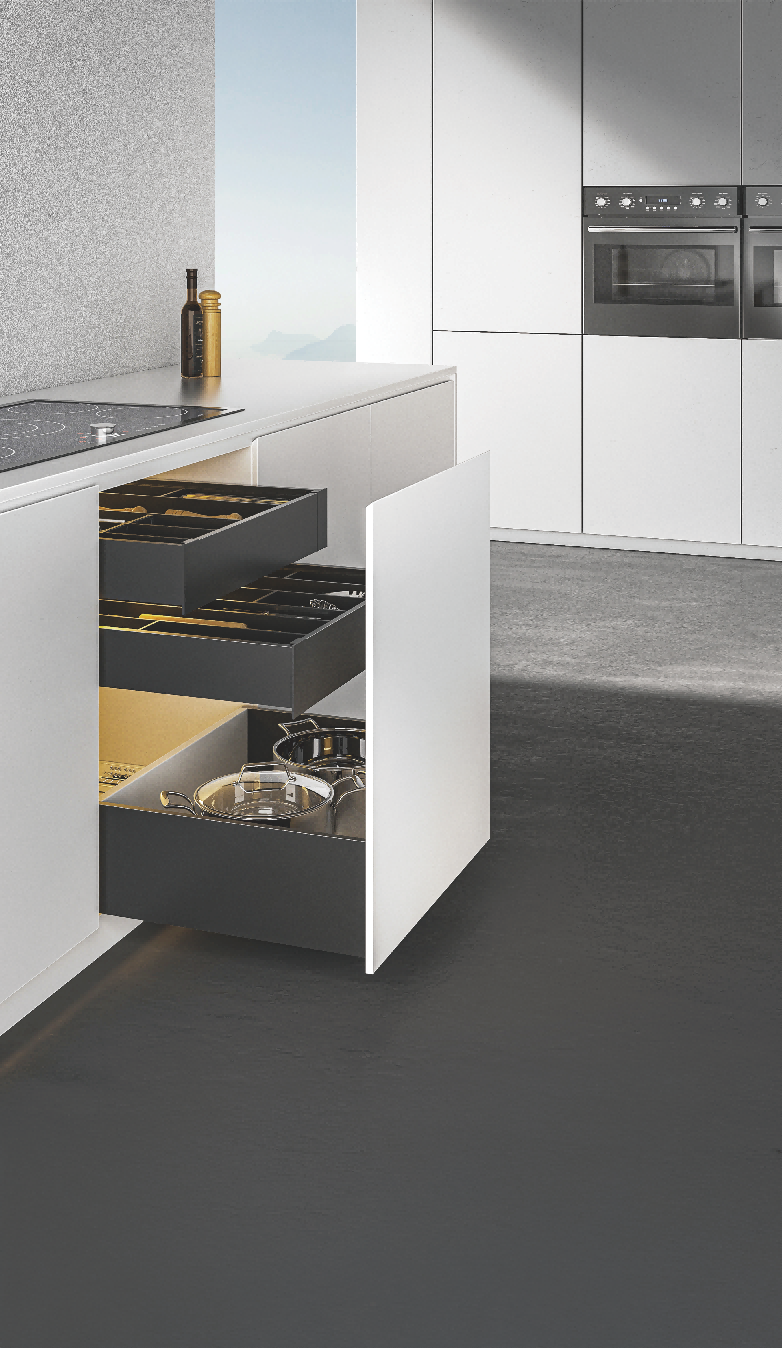
Core Reasons Why Slim Drawer Systems Have Become the Global Universal Standard
Among all drawer categories, slim drawer boxes record unmatched market growth momentum, driven by four core factors:
Larger Internal Storage Volume
Ultra-narrow side panels reduce structural occupation and maximize usable internal drawer space.
Alignment With Global Minimalist Home Decoration Trends
Modern kitchen design favors clean straight lines and visual simplicity.
Comprehensive Upgrade of User Experience
Slim drawers are generally equipped with a new generation of silent buffer structures and concealed slides.
Improved Market Positioning for Finished Products
Furniture brands can create clear product differentiation to widen grade gaps within competitive markets.
Kitchen design will continue prioritizing both aesthetics and practicality in the coming years, keeping slim drawer systems as the core high-growth track of the industry long-term.
Conclusion
Modern cabinet drawer systems are far more than simple furniture accessories; they constitute a set of highly precise industrial solutions that directly determine cabinet storage efficiency, cabinet durability, installation construction efficiency and overall end-user experience.
Distributors, importers and cabinet manufacturers must comprehensively assess product mechanical performance, mass production stability, rust-proof capability, durability test data and overall supplier strength during sourcing and selection.
Global purchasing demand keeps shifting toward three core categories: concealed slides, soft-close buffer mechanisms and slim drawer boxes. Procuring matching high-quality drawer products by fully understanding mainstream industry trends allows brands to deliver market-competitive cabinetry with steady long-term profit margins to end customers.
Contact Us
Are you seeking stable, reliable cabinet drawer system supply for your furniture projects? Contact our team immediately to receive full product catalogs, detailed technical specifications, OEM customization support and export quotations.
Post time: Jun-30-2026


