


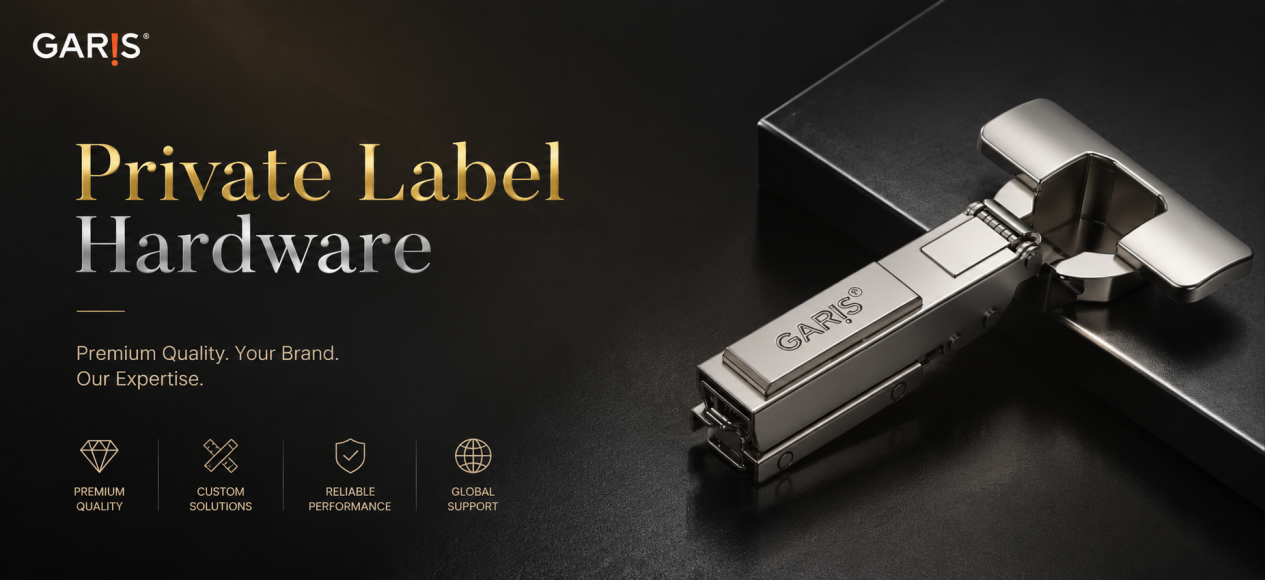
In terms of the home hardware industry, one trend becomes very clear: more and more customers are no longer just focused on “what products to buy,” but instead on “what products they can sell under their own brand.” This is what we call Private Label Hardware.
For me, this change didn’t happen suddenly. It has been building up step by step. In recent years, whether it’s cabinet brands in Europe or hardware distributors in the Middle East and South America, more and more of them are trying to turn their supply chains into brand assets.
1. What is Private Label Hardware?
Simply put, factories produce hardware products, but the products carry the customer’s own brand instead of the factory’s brand.
Products like hinges, drawer slides, handles, and push-to-open systems don’t have major functional differences in essence. But once different brands are applied, their market positioning, pricing, and customer perception become completely different.
For factories, this is “OEM + customization.”
For customers, it is about “building their own branded product line.”
2. Why are more customers choosing Private Label?
I have worked with many customers who started as traders or agents of branded products, but gradually moved toward Private Label. The reasons are very practical:
1. Higher profit margins
When acting as an agent, pricing is transparent and profit is limited. With private label, you can redefine the pricing structure and gain much better control over margins.
2. More control in competition
When everyone sells the same hinge, competition becomes purely price-driven. But with your own brand, customers evaluate not only price, but also service, consistency, and brand trust.
3. Easier to build long-term customer relationships
Customers are not just buying a product—they are buying your brand. Once recognition is built, switching costs become higher.
3. Private Label is not just rebranding
Many people first think Private Label simply means “changing the logo.” But in real practice, it is far more complex.
Here are the key points:
1. Product stability is the foundation
Hardware is not a fast-moving consumer product. Especially for hinges and drawer slides that open and close dozens of times a day, stability is more important than anything else.
2. Packaging and brand consistency
From outer cartons to inner packaging and instruction manuals, every detail reflects the brand image. Poor execution can easily make the brand look unprofessional.
3. Customization capability is crucial
Different markets have different needs. For example, Europe focuses more on certifications and load testing, while the Middle East may care more about appearance and cost performance. Private Label requires flexibility.
4. Delivery stability
Once customers build a brand, what they fear most is not high price—but stock shortages. Supply chain stability directly affects brand reputation.
4. The role of factories in Private Label
From a factory’s perspective, our role is not just a “manufacturer,” but more like a “brand support system.”
A good cooperation model usually looks like this:
● The customer is responsible for marketing, branding, and sales channels
● The factory is responsible for R&D, production, and quality control
If both sides work well together, customers can focus more on market expansion instead of being held back by production details.
In real cooperation, we often do some “invisible work,” such as:
● Adjusting product structures based on target markets
● Optimizing packaging design to ensure brand consistency
● Providing test reports and certification support
● Maintaining consistent quality across different production batches
These things may not always be visible to the customer in the market, but they determine whether a brand can survive in the long run.
5. Challenges of Private Label
Of course, this path is not easy.
1. Longer lead time at the beginning
Unlike buying ready stock, Private Label requires sampling, confirmation, and revisions, which takes more time.
2. Higher communication cost
Brand clients often have more detailed requirements, including color, texture, packaging, and other small details that require repeated confirmation.
3. Higher requirements for factories
Not all factories are suitable for Private Label. If the production system is unstable, it can easily affect the entire brand plan.
6. Future trend: It’s not about whether there is a brand, but whose brand it is
In the home hardware industry, the future will become clearer:
Low-end markets compete on price, while high-end markets compete on brand.
Private Label Hardware is essentially a bridge—it allows traders to transform into brand owners.
For factories, it is also an opportunity for transformation:
From “order-based manufacturing” to “brand partner.”
Conclusion
Products can be copied, but brands cannot.
Private Label Hardware is not just a business model—it is a long-term mindset. It means turning the supply chain into part of the brand, and turning the factory into part of the brand.
If you are working in the home hardware industry—whether you are a trader or a distributor—it may be worth seriously thinking about one question:
Are you selling products, or are you building your own brand?

Post time: Jul-20-2026


