


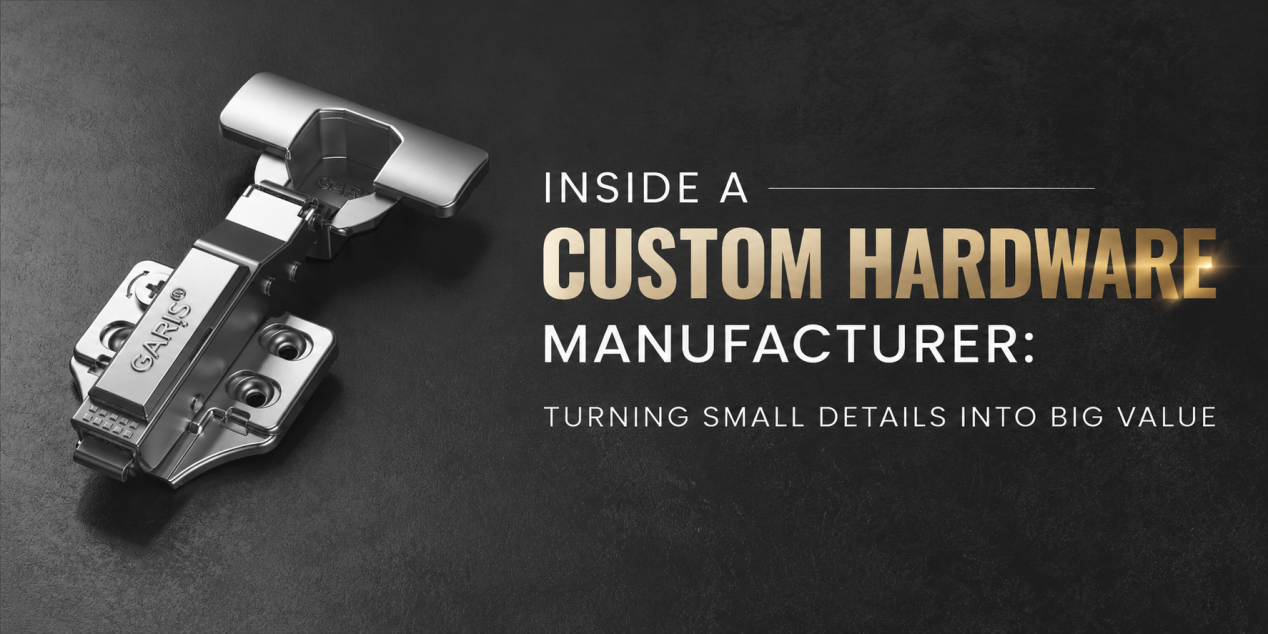
I work in export sales for a precision hardware company in Guangdong, China. Every day I talk to cabinet makers, furniture brands, distributors, and sourcing agents from different countries. And over time, I’ve noticed one simple truth: most people don’t just want “hardware.” They want hardware that actually fits their product, their market, and sometimes even their brand story.
That’s where custom hardware manufacturing really matters.
When people hear “custom,” they often think it means expensive or complicated. But in reality, it usually starts much simpler: a drawer slide that fits a specific cabinet depth, a hinge that closes softer than standard, or a handle design that matches a brand’s new furniture line. Small changes, big impact.
In my company, we don’t just produce standard catalog items and stop there. We spend a lot of time adjusting details—material thickness, surface finish, load capacity, size tolerance, even packaging style—based on what customers actually need in their market. That’s what makes us a custom hardware manufacturer, not just a factory.
Why customization matters more than people think
I’ve had customers tell me things like:
● “Your sample is good, but it doesn’t fit our cabinet structure.”
● “We like the quality, but the finish doesn’t match our furniture style.
● “Can we make it slightly quieter when closing?”
These are not big changes on paper. But in real production, they decide whether a product feels premium or average.
For example, in some European markets, customers care a lot about smooth closing and noise control. In some Middle Eastern projects, durability under heat and heavy use is more important. In Southeast Asia, cost control and corrosion resistance often come first because of humidity.
So if you try to sell the same hardware everywhere without adjusting anything, it usually won’t last long in real business.
What “custom hardware” really looks like in practice
Let me be honest: customization is not about reinventing everything. Most of the time, it’s about fine-tuning.
Here are a few real examples from daily work:
A cabinet hinge might look the same from the outside, but we can adjust:
● Opening angle (95°, 125°, 155°)
● Soft-close speed
● Cup depth for different door thickness
● Surface coating for salt spray resistance
A drawer slide might be customized by:
● Load capacity (from light duty to heavy duty storage)
● Extension type (single extension or full extension)
● Material thickness for stability
● Noise level during sliding
None of this looks dramatic alone. But together, they decide how a furniture brand feels in the market.
The real job behind a custom manufacturer
Many people think our job is just production. But in reality, a big part of my work is communication.
I spend a lot of time understanding what customers don’t say directly. Because most buyers won’t say “I need a hinge that lasts 50,000 cycles.” They will say:
- ● “We had complaints after six months.”
- ● “We want something more stable.”
- ● “Our customers expect better quality.”
So I ask questions, test samples, adjust drawings, and go back and forth until the product feels right.
This process can take days or weeks, sometimes longer. But that’s normal. Custom hardware is not instant—it’s built through feedback.
Why factories in China play a big role
I often get asked why so many furniture brands source hardware from China.
My honest answer is simple: flexibility and experience.
In Guangdong, especially, there are entire supply chains built around furniture hardware. That means we can quickly switch materials, adjust tooling, and produce samples without long waiting times. If a customer wants a change, we don’t need to rebuild everything from zero.
Also, many factories here have already worked with global markets for years. So we are used to different standards—European testing, American usage habits, Middle East climate conditions. This experience becomes very practical when developing custom solutions.
Mistakes buyers often make when choosing hardware
From what I’ve seen, there are a few common misunderstandings:
1. Thinking standard products are “good enough”
They often work at the beginning, but later problems appear in real use—loose hinges, noisy slides, or inconsistent finishes.
2. Only focusing on price
Hardware is a small part of furniture cost, but it affects user experience every day. Saving a little on hardware can create long-term complaints.
3. Ignoring testing
Many buyers skip cycle testing or salt spray testing to save time. But hardware failure usually happens after months, not during purchase.
What makes a good custom hardware manufacturer
From my experience, it’s not just about machines or factories. It’s about three things:
First: listening.
If a manufacturer doesn’t understand your market needs, customization is just guessing.
Second: consistency.
One good sample is easy. Keeping the same quality in mass production is the real challenge.
Third: honesty.
Sometimes a request sounds simple but is not realistic. A good manufacturer should explain clearly instead of just saying yes.
I’ve learned that customers don’t really want “perfect products.” They want reliable solutions that fit their real situation.
A cabinet hinge is not just a hinge. It’s the feeling of opening a kitchen every morning. A drawer slide is not just metal parts. It’s the smooth experience when someone stores or takes out something important.
When I think from this angle, custom manufacturing is not about making things complicated. It’s about making things fit better.
Final thoughts
Being a custom hardware manufacturer means we are not only producing metal parts. We are helping furniture brands solve real problems in real homes, offices, and commercial spaces.
Every project is slightly different. Every market has its own habits. And every customer has their own expectations.
That’s why I still believe customization is not a trend—it’s the direction the industry is moving toward.
And in my daily work, I’m not just selling hardware. I’m helping people turn small details into better products.

Post time: Jul-16-2026


